


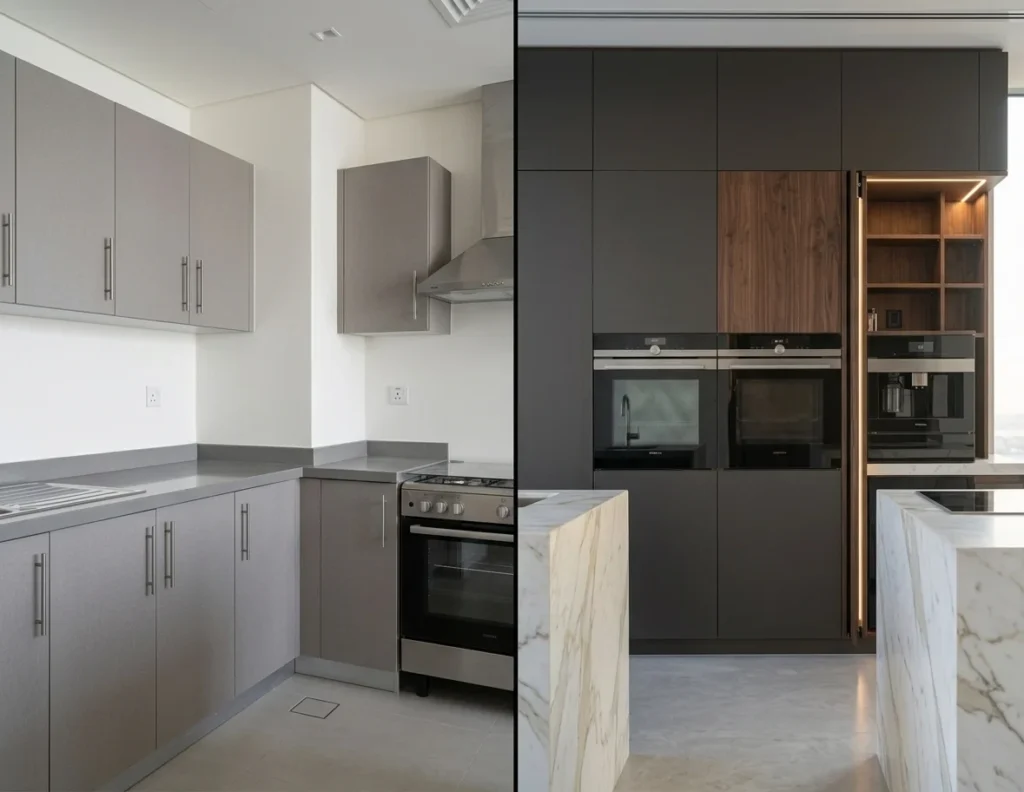
If you are planning a home remodel and calculating your total kitchen renovation cost in Dubai, you have likely started gathering quotes for your new kitchen and run into a confusing price gap.
On one side of the market, you can find a company promising a complete modular kitchen setup for AED 25,000 to AED 30,000. On the other side, a premium custom design studio quotes you upwards of AED 100,000 for what looks, at first glance in a 3D render, like a very similar layout.
It is easy to look at those numbers and wonder: Are you simply paying a premium for a luxury brand name? Or is there a physical, structural difference that justifies spending three times more?
The truth is, in the kitchen industry, the difference between an average kitchen and a luxury masterpiece isn’t found in the big, obvious things. It is found in the hidden details—specifically, in the 1mm tolerances.
Let’s pull back the curtain and look at the actual engineering, material science, and manufacturing standards that separate a budget-built kitchen from a high-end, custom-engineered masterpiece.
1. The Carcass: Dense Integrity vs. Budget Fillers
Every kitchen is built around a box, known in the industry as the cabinet carcass. This is the structural skeleton that supports the weight of heavy stone countertops, holds up built-in appliances, and anchors every drawer and door hinge.
In a budget kitchen (typically in the AED 30,000 range):
- The carcass is almost always constructed from low-density, 16mm thick chipboard or basic particleboard.
- These boards are loosely compressed, making them soft and highly susceptible to moisture absorption.
- Over time, the weight of a heavy marble or quartz countertop will cause the thin cabinet tops to sag. Worse, because the wood fibers are loose, the screws holding your heavy soft-close hinges will slowly strip the wood, causing your beautiful cabinet doors to sag and lose their alignment.
In a luxury, high-end kitchen (AED 100,000+):
- The carcass is constructed using a minimum of 18mm high-density, moisture-resistant (MR) MDF or multi-layered marine plywood.
- These materials are incredibly dense and structurally rigid. They are engineered to bear massive loads without a single millimeter of deflection.
- The dense core means that screws stay locked in place forever, ensuring that your cabinet doors stay perfectly straight and level, even after thousands of openings and closings.
2. Edge Sealing: PUR Invisible Joins vs. Delaminating Corners
Look closely at the edge of a cheap kitchen cabinet door. You will often see a thin, visible line of glue where the edge strip meets the main panel surface.
In budget manufacturing, edge banding is applied using standard EVA hot-melt glues. While fast and cheap to apply, EVA glue acts like a wax; it is sensitive to heat and moisture. In Dubai’s humid environment, or when positioned near hot cooking zones and steaming dishwashers, EVA glue softens. Within a couple of years, the edge strip begins to peel (delaminate), exposing the raw wood beneath to water damage.
A premium kitchen relies on Polyurethane (PUR) bonding technology to apply edge banding.
Instead of just drying, PUR glue undergoes a chemical reaction with the moisture in the air to create an irreversible, completely waterproof bond. The adhesive layer is so microscopic that the joint looks entirely seamless—as if the cabinet door was carved from a single, solid block of material. The edges will never peel, bubble, or allow water to penetrate, even over decades of intense household use.
3. The Hardware: Weight Tolerances and Lifetime Silence
The easiest way to test the quality of a kitchen is with your fingertips.
Budget modular kitchens are built using standard, generic runner systems and hinges to keep costs down. When the drawers are empty in a showroom, they feel fine. But when you load them up with heavy cast-iron pots, stacks of dinner plates, and pantry items, the reality changes. The drawers struggle under the weight, they require extra effort to pull open, and the soft-close mechanism begins to feel clunky or fails to shut completely.
A luxury kitchen is engineered using world-class hardware systems, such as Blum (Legrabox profiles) or Hettich runner systems.
These elite systems are rated to hold dynamic weights of 40kg to 70kg per drawer without losing an ounce of their smooth, silent, effortless glide. They feature integrated liquid dampers that calculate the closing speed based on how hard you push the drawer, ensuring a smooth, silent close every single time. This hardware is built and certified to last over 200,000 open-and-close cycles—meaning your kitchen will perform as flawlessly in year 25 as it did on day one.
4. Millimeter Customization vs. “Standard Block” Limitations
When you buy a budget kitchen, you are usually purchasing “standard blocks.” These factories manufacture cabinets in fixed sizes—typically in increments of 15cm (e.g., 30cm, 45cm, 60cm, 90cm).
If your kitchen wall is 342cm long, your designer has to use five 60cm cabinets and one 30cm cabinet, leaving an awkward 12cm gap at the end. To fix this, they install a thick “filler panel” to close the gap. While this technically closes the wall, it looks unpolished and wastes valuable storage space.
A luxury custom design studio works with a 1mm tolerance standard. There are no “standard blocks” to restrict your layout.
If your wall is 342cm, every cabinet is custom-sliced in the factory to be exactly 57cm wide. The result is a mathematically perfect, symmetrical wall of cabinetry that looks incredibly clean, feels balanced to the eye, and maximizes every single cubic centimeter of available storage space.
5. Countertop Fabrication: The Mitered Edge Detail
The countertop is the crown jewel of your kitchen. In a high-end project, this countertop is often made of premium materials like Calacatta marble, engineered quartz, or high-tech porcelain.
In a budget installation, to save on labor costs, stone pieces are joined together using basic straight cuts, resulting in a visible seam running down the corner of your island. Over time, dirt and grime accumulate in this seam, creating a dark, unhygienic line.
In a luxury installation, the stone is processed using advanced water-jet CNC machines. Every corner joint is cut at a precise 45-degree angle (a mitered edge) and joined together with color-matched epoxy resins.
When done correctly, the vein of the stone wraps seamlessly over the edge and cascades down to the floor, creating the illusion of a solid, heavy block of stone resting in your kitchen. There are no raw seams, no rough edges—just continuous, architectural beauty.
Evaluating Your Kitchen Renovation Cost in Dubai and ROI
When deciding on a budget for your kitchen renovation, it helps to shift your perspective from cost to lifetime value.
A AED 30,000 kitchen might seem like a great deal today, but if the cabinet doors begin to sag, the laminate edges start to peel, and the drawer tracks fail in four or five years, you will be forced to undergo a disruptive, costly replacement all over again.
A custom-engineered AED 100,000 kitchen is built as a permanent architectural installation. It is built to survive the climate, handle the heavy demands of daily cooking, and elevate the resale value of your property for decades to come.
Planning Your Space?
If you are currently planning a kitchen renovation in Dubai and want to see how to allocate your budget effectively, we are here to help:
- Use our interactive kitchen cost calculator to get an instant, transparent estimate for your custom layout.
- Book a private, one-on-one consultation at our Sheikh Zayed Road design office to discuss your project’s engineering, material selections, and floor plans with our specialist team.